
On this day, the eighth Sunday of Pascha, we celebrate the day of Holy Pentecost.
We have also taken the celebration of this feast from the Jews. Their celebration of Pentecost was both in honor of the number seven as well as in remembrance of the fact that they received the Law fifty days after the Passover. Thus we also celebrate fifty days after Pascha, receiving the One who gives us the Law, the most Holy Spirit, who guides us in all truth and teaches us what is pleasing to God. It should also be known that among the Jews were three great feasts: Passover, Pentecost; and the Feast of the Tabernacles. Passover was in remembrance of passing through the Red Sea, for the name of the feast itself is one of “passing.” That feast prefigured our own Pascha, which is the passing and returning from the darkness of sin to Paradise.
The second feast celebrated by the Jews, Pentecost, was a reminder of their sufferings in the desert and the hardships through which they passed in order to reach the Promised Land. It was only after these hardships that they could taste the fruits, the wheat and the wine. For us, however, Pentecost shows the departure from the wickedness of unbelief and the entrance into the Church so that we may commune of the Body and Blood of the Master. Many say that Pentecost is celebrated among the Jews in honor of the fact that the holy Prophet Moses fasted fifty days before receiving the God-written Law and the many other events that occurred as he ascended and descended Mount Sinai. Some hold that the Jews celebrated Pentecost for the reasons shown above; others, however, feel that Pentecost was established by the Jews according to the honor given to the number seven, as we have mentioned. This number, multiplied by itself, comes to one less than fifty. The honor that the Jews gave to Pentecost depends not only upon the number of days, but also on the number of years, for this decided the years of the celebration of the Jubilee, named the Time of Forgiveness, or Release, which fell every fifty years. On that year, they would leave the earth fallow and allow the animals to rest, and any slaves who were purchased at a price were given freedom to leave. (See Lev. 25.)
31.05.2026Read more

Holy Fathers of the First Ecumenical Council, with Emperor Constantine
(Arius, whose heresy was repudiated, is underneath them)
On the seventh Sunday of Pascha, we celebrate the three hundred eighteen God-bearing Fathers of the First Ecumenical Council held in Nicaea of Bithynia.
The reason we celebrate this feast today is as follows: after our Lord Jesus Christ took flesh and fulfilled His ineffable dispensation for us, He returned to the throne of the Father. It was the desire of the Saints to show that the Son of God had truly become man, that He had ascended as perfect man and perfect God into Heaven and is seated at the right of the glory on high. This council of Holy Fathers proclaimed and confessed that the Son is of the same essence and honor as the Father. Therefore, following the feast of the glorious Ascension, this present feast has been set forth in order to add to the already large number of Fathers who preached that He Who has Ascended in the flesh is both perfect God and perfect Man in the flesh.
24.05.2026Read more
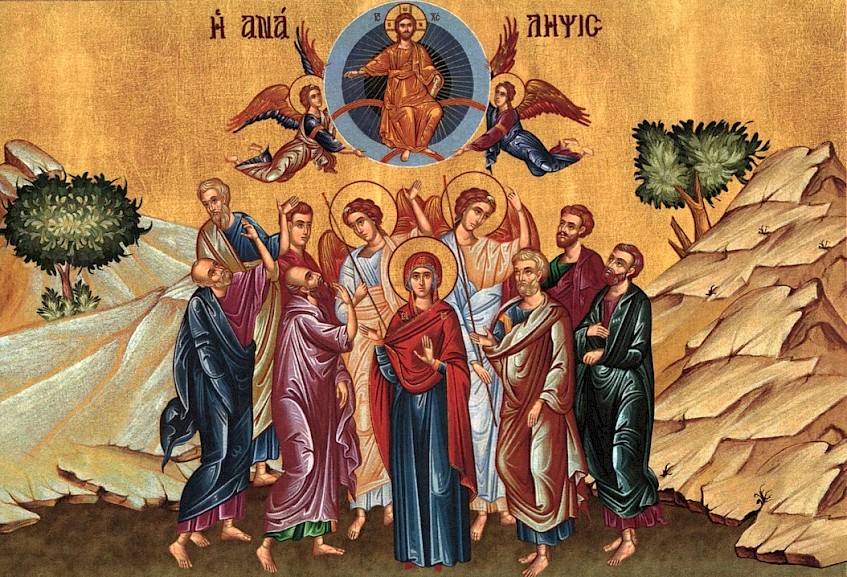
Οn Thursday of the sixth week after Pascha, we celebrate the Holy Ascension of our Lord God and Savior Jesus Christ.
While the Savior was still together with the Disciples, before the Passion, He promised that the most Holy Spirit would come, saying, “Nevertheless I tell you the truth. It is to your advantage that I go away; for if I do not go away, the Helper will not come to you; but if I depart, I will send Him to you” (John 16:7) and, “However, when He, the Spirit of Truth, has come, He will guide you into all truth...” (John 16:13). That is why, after the Resurrection from the dead, having shown Himself to them during the period of forty days – not constantly, but from time to time – eating and drinking together with them and clearly revealing the Resurrection to them, on the final day, He promised them many things about the Kingdom of God. He commanded that they not leave Jerusalem but remain there and wait for the coming of the most Holy Spirit, for they needed to be baptized in the Spirit, having been baptized before only with John’s baptism of water. Thus, He commanded them to stay in Jerusalem so they would be strengthened by preaching the Gospel first in that very place instead of going to foreign lands immediately where they would more easily be ridiculed. This was also necessary so that they would be trained there, like soldiers, with the weapons of the Spirit, and thus they would go out for battle in preaching the Gospel.
22.05.2026Read more
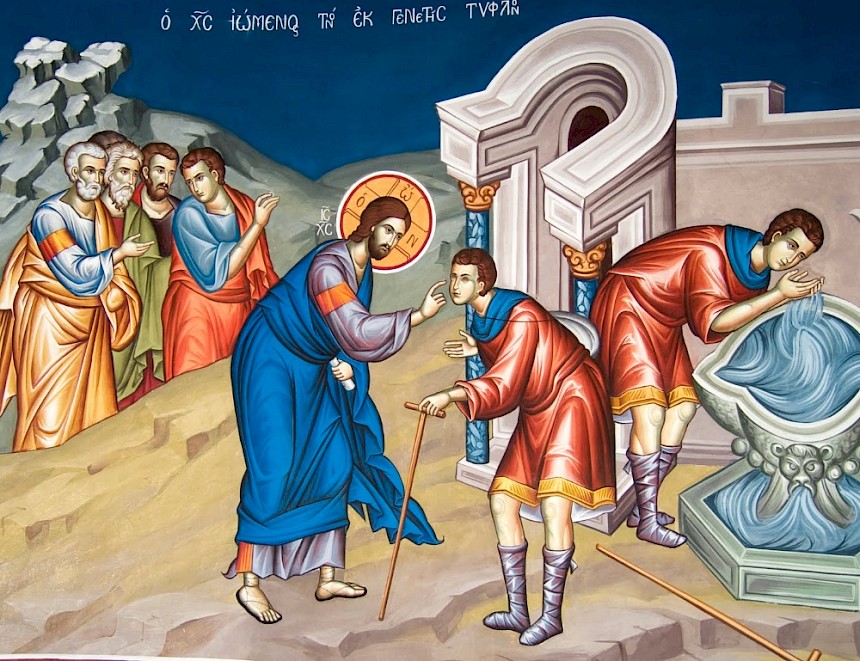
On this day, the sixth Sunday of Pascha, we celebrate the miracle which our Lord God and Savior Jesus Christ performed for the man who had been blind from birth.
This miracle, like those of the Samaritan woman and the paralytic, was brought about through the use of water in this way: As Christ was speaking with the Jews and showing them that He is together with the Father, existing before Abraham, they sought to stone Him. He then left that place where He had been speaking with them and met a blind man who was wandering about and who had been blind from birth, having only the shape and form of eyes. When the Savior saw him, His Disciples asked, “Rabbi, who sinned, this man or his parents, that he was born blind?” (John 9:2). The reason they asked this is because they had heard Him telling the paralytic at the Sheep's Pool, “Behold, you have been made well. Sin no more, lest a worse thing come upon you” (John 5:14), as if to say that “the sins of the parents are visited upon the children...”
17.05.2026Read more

On the fifth Sunday of Pascha, we celebrate the feast of the Samaritan woman.
This feast has been placed during the week of Mid-Pentecost because Jesus, on this day, clearly bore witness to Himself as the Messiah, that is, the Christ or anointed One (for Messiah in Hebrew means anointed one), and also because He had worked the miracle at the Sheep’s Pool on the previous Sunday.
Christ spoke with the Samaritan woman at Jacob’s well, the well which Jacob himself had dug and then given to his son Joseph. (See Gen. 49:22.) This was a chosen place, close to the mountains of Samaria, and it was there that many Samaritans lived; however, it was the Jews, not the Samaritans, who were the first to have lived in that region. But the Jews, having turned against God, were overcome by the Assyrians in two consecutive battles, and the victors assumed possession of that area. During the reign of King Hoshea, the Israelites aligned themselves with the Egyptians; when the Assyrians heard this, they deported the Jews to Babylon and decided that the region of Samaria would be the habitation of a number of different peoples. But God brought lions upon the foreigners because they did not know how to render Him proper worship, and when the king of the Assyrians heard of this, he sent for a priest from among the Jews (who were in a state of slavery) to be brought back to convince the peoples to accept the law of God. (See 2 Kings 17.) The various peoples immediately renounced their idolatry, but they would accept only the five books of Moses, refusing to accept the books of the prophets and the other books of the Old Testament. These people were then called Samaritans, after the name of Mount Samaria. They were hated by the Jews when the latter returned from slavery, for the Samaritans appeared to be only half-Jewish. The Jews refused to have anything to do with the Samaritans, considering them as unworthy. That is why they often called Christ a Samaritan, indicating that He, like the Samaritans, in their estimation broke parts of the law.
10.05.2026Read more
